

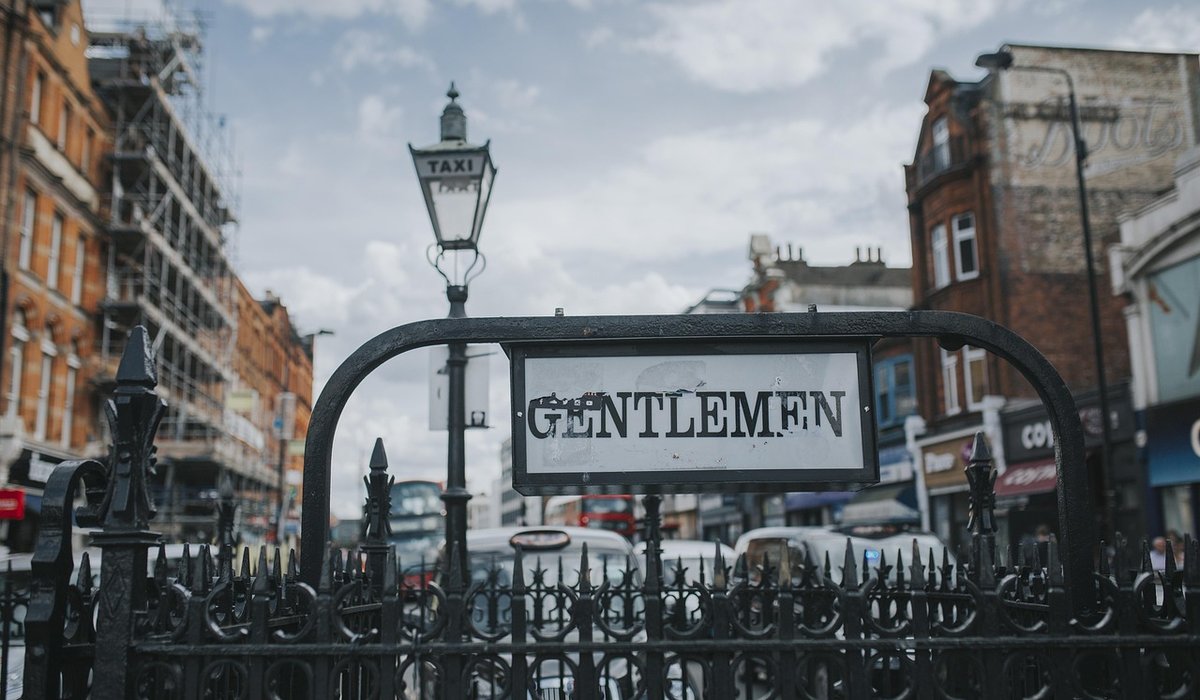
Why Leading Lines Matter In A Crowded Frame
A city is a busy place to photograph. Signs, windows, pedestrians, traffic, scaffolding and shopfronts all compete for attention, and the eye arrives without knowing where to settle. Leading lines solve that problem quietly. They are any linear feature in the frame that pulls the viewer's gaze from one part of the image towards another, and usually towards whatever you have decided matters most.
The beauty of them is that you do not need special equipment or permission. A kerb, a set of railings, a painted road marking or a long shadow all do the job. Once you start noticing them, you will find that most good urban photographs have at least one, even if the photographer never consciously planned it.
Beyond guiding the eye, lines carry mood. Horizontal lines feel calm and settled. Verticals feel formal and strong. Diagonals feel energetic and slightly unstable, which is why they suit street scenes so well. Converging lines create depth, echoing the way we actually experience a street receding into the distance.
Where To Look: Lines Hiding In Plain Sight
The trick is to slow down and scan the ground, the walls and the sky before you lift the camera. Useful sources include:
- Kerbs and road markings — dashed white centre lines, double yellows, bus lane edges and zebra crossing stripes are all ready-made guidelines.
- Railings and fences — canal towpaths, park boundaries and riverside walkways are lined with them, and they compress beautifully in a long lens.
- Tram and rail tracks — Manchester, Sheffield, Nottingham, Birmingham and Edinburgh all offer gleaming metal lines that curve and cross in the most photogenic ways.
- Building edges — the receding roofline of a Victorian terrace or a run of identical windows creates a rhythm that carries the eye along.
- Underpasses and subways — tiled walls, handrails and ceiling lights produce near-perfect one-point perspective.
- Shadows — a row of railings or lamp posts casting stripes across a pavement on a bright day is one of the most underrated compositional tools in the UK.
Choosing Your Position: Get Low, Get Close, Get Off-Centre
Leading lines are mostly about where you stand, not what you carry. Move a couple of metres closer to the line and it becomes dominant rather than decorative. Crouch down and a kerb that looked ordinary at eye level suddenly sweeps across the frame like a runway.
If you want symmetry, stand dead centre. A canal path, a bridge, a shopping arcade or a tree-lined avenue all reward a centred composition, because the lines converge on a single vanishing point and the image feels ordered and deliberate. If you want energy, step to one side so the lines run diagonally from a corner instead. That slight shift changes a polite photograph into a dynamic one.
Watch the edges of the frame too. Lines that enter at an awkward point, or that lead the eye straight out of the picture, weaken the whole composition. Half a step sideways is often all it takes to bring everything back into balance.
Making The Line Lead Somewhere
A leading line with no destination is just a stripe. It needs a payoff: a lone figure walking away, a distinctive lamp post, a bright red door, a patch of sunlight on a wall, a cyclist crossing at the far end. The line is the invitation; the subject is the reward.
Technically, you will usually want a decent depth of field so the whole line stays sharp. Apertures around f/8 to f/11 work well on most lenses. Focus roughly a third of the way into the scene rather than on the horizon, and the foreground and mid-ground will both hold up. If you are hand-holding in low light, raise the ISO rather than sacrificing sharpness with a slow shutter speed.
Then be patient. Wait for someone to step into the gap at the end of your line. Half a minute of standing still is often the difference between a tidy record shot and something with a bit of life in it.
Working With British Light And Weather
Our weather is not the obstacle it is often made out to be. Overcast days are excellent for this kind of photography, because soft light keeps every line readable, from white road markings to dark brickwork. The trade-off is flatness, so look for tonal contrast — a pale line against dark tarmac, or a dark shadow across pale stone.
Rain is a gift. Wet pavements bounce light back upwards and double every line in reflection. A shallow puddle at your feet can turn a routine street scene into something graphic, especially if you get low and let the reflection become the main event.
Low winter sun is the other great ally. Between November and February the sun sits so low that railings, bollards and bare trees throw long shadows right across your path — natural leading lines that vanish by midsummer. Late afternoon in a northern city, with the light raking down a street, is hard to beat. In blue hour, when streetlights come on and the road is still wet, the lines glow.
Five Lines To Try This Week
- A station platform — kneel low and shoot along the yellow safety line as a train approaches.
- A canal towpath — stand under a bridge and let the railings and water edge converge.
- A rooftop or multi-storey car park — look down a road and use lane markings to lead to a distant landmark.
- A riverside walkway — use steps, railings and the water's edge at low tide for layered diagonals.
- A shopping arcade or covered market — work the tiled floor and ceiling lights for symmetry.
Pick one, spend an hour on it, and resist the urge to move on too quickly. Leading lines reward the photographer who stands still, looks carefully and waits for the scene to arrange itself. Do that a few times and you will start seeing them everywhere — which is exactly when urban photography becomes far more enjoyable.


Coding is used in almost all aspects of life and work now, be it directly or indirectly. It’s not just for companies in the tech sector. “An increasing number of businesses rely on computer code,
Coding is used in almost all aspects of life and work now, be it directly or indirectly. It’s not just for companies in the tech sector. “An increasing number of businesses rely on computer code,
Coding is used in almost all aspects of life and work now, be it directly or indirectly. It’s not just for companies in the tech sector. “An increasing number of businesses rely on computer code,